Pool water chemistry can seem intimidating when you first start learning about it. pH, chlorine, alkalinity, stabiliser, calcium hardness - the list of parameters goes on. But understanding the basics is not as complicated as it seems, and knowing what to test (and why) is one of the most important skills a pool owner can develop.
Properly balanced water keeps your pool safe to swim in, protects your equipment from damage, and prevents costly problems like algae blooms, surface staining, and scale buildup. Here is a plain-language guide to pool water testing for Perth pool owners.
The Essential Parameters
Free Chlorine
What it does: Chlorine is your pool’s primary sanitiser. It kills bacteria, viruses, and algae, keeping the water safe for swimming.
Ideal range: 1 to 3 ppm (parts per million)
Testing frequency: At least twice per week in summer, weekly in winter
What happens when it is off:
- Too low (below 1 ppm): Algae growth, bacterial contamination, cloudy water. In Perth’s warm climate, a pool can go from clear to green in 48 hours when chlorine drops to zero.
- Too high (above 5 ppm): Eye and skin irritation, swimwear fading, strong chlorine odour. Ironically, a strong “chlorine smell” often indicates combined chlorine (chloramines), not high free chlorine.
Perth-specific note: Perth’s intense UV radiation breaks down chlorine faster than in less sunny climates. This makes stabiliser (cyanuric acid) essential and means chlorine levels should be checked more frequently during summer.
pH
What it does: pH measures how acidic or alkaline your pool water is, on a scale from 0 (most acidic) to 14 (most alkaline). It affects chlorine effectiveness, swimmer comfort, and equipment longevity.
Ideal range: 7.2 to 7.6
Testing frequency: At least twice per week in summer, weekly in winter
What happens when it is off:
- Too low (below 7.0): Water becomes corrosive. It can etch concrete and plaster surfaces, corrode metal fittings, damage pump seals, and cause skin and eye irritation. Chlorine becomes very effective at low pH, but the trade-off in equipment damage is not worth it.
- Too high (above 7.8): Chlorine effectiveness drops dramatically. At pH 8.0, chlorine is only about 20 per cent as effective as at pH 7.2. Scale forms on surfaces and equipment, water becomes cloudy, and skin irritation increases.
The relationship with alkalinity: pH is strongly influenced by total alkalinity. If you are constantly adjusting pH and it keeps drifting, the real issue is likely your alkalinity level.
Total Alkalinity
What it does: Alkalinity acts as a buffer for pH, preventing it from swinging wildly up and down. Think of it as the anchor that keeps your pH stable.
Ideal range: 80 to 120 ppm
Testing frequency: Weekly in summer, fortnightly in winter
What happens when it is off:
- Too low (below 60 ppm): pH becomes unstable and difficult to manage. It fluctuates rapidly, and you find yourself constantly adding acid or soda ash to chase the pH number.
- Too high (above 150 ppm): pH tends to drift upward and resist correction. Scale formation increases, and the water may become cloudy.
How to adjust: To lower alkalinity, add hydrochloric acid (muriatic acid) with the pump off, pouring it slowly into the deep end. To raise alkalinity, add sodium bicarbonate (bicarb soda). Alkalinity adjustments also affect pH, so make alkalinity corrections first, then fine-tune pH.
Cyanuric Acid (Stabiliser)
What it does: Stabiliser protects chlorine from UV degradation. Without it, Perth’s intense sunshine would destroy your chlorine within a few hours.
Ideal range: 30 to 50 ppm
Testing frequency: Monthly (stabiliser changes slowly)
What happens when it is off:
- Too low (below 20 ppm): Chlorine is unprotected and burns off rapidly in sunlight. You will find yourself adding chlorine constantly and still not maintaining adequate levels.
- Too high (above 80 ppm): Chlorine becomes progressively less effective. At 100+ ppm, even heavily chlorinated water may fail to prevent algae growth. This is called chlorine lock.
Critical Perth issue: Over-stabilisation is the single most common water chemistry problem we see in Perth pools. Stabiliser accumulates over time and cannot be removed by filtration, evaporation, or chemical treatment. The only solution is to partially drain the pool and refill with fresh water. Many Perth pool owners unknowingly add stabiliser every time they use stabilised chlorine products (granular chlorine, trichlor tablets), causing a gradual and invisible buildup.
Calcium Hardness
What it does: Calcium hardness measures the amount of dissolved calcium in your pool water. Pool water naturally seeks a calcium equilibrium, and if the water is calcium-deficient, it will leach calcium from your pool surfaces.
Ideal range: 200 to 300 ppm (for concrete/plaster pools) or 150 to 250 ppm (for fibreglass pools)
Testing frequency: Monthly
What happens when it is off:
- Too low: The water becomes aggressive and dissolves calcium from plaster, grout, and stone surfaces. This causes etching, pitting, and premature surface wear.
- Too high (above 400 ppm): Calcium deposits form as scale on surfaces, inside pipes, and on the chlorinator cell. Scale reduces equipment efficiency and is difficult to remove once established.
Perth-specific note: Perth’s scheme water has moderate calcium levels, and bore water (still used in some suburbs for pool top-ups) can have high calcium. Regular testing prevents surprises.
Testing Methods
Liquid Reagent Test Kits
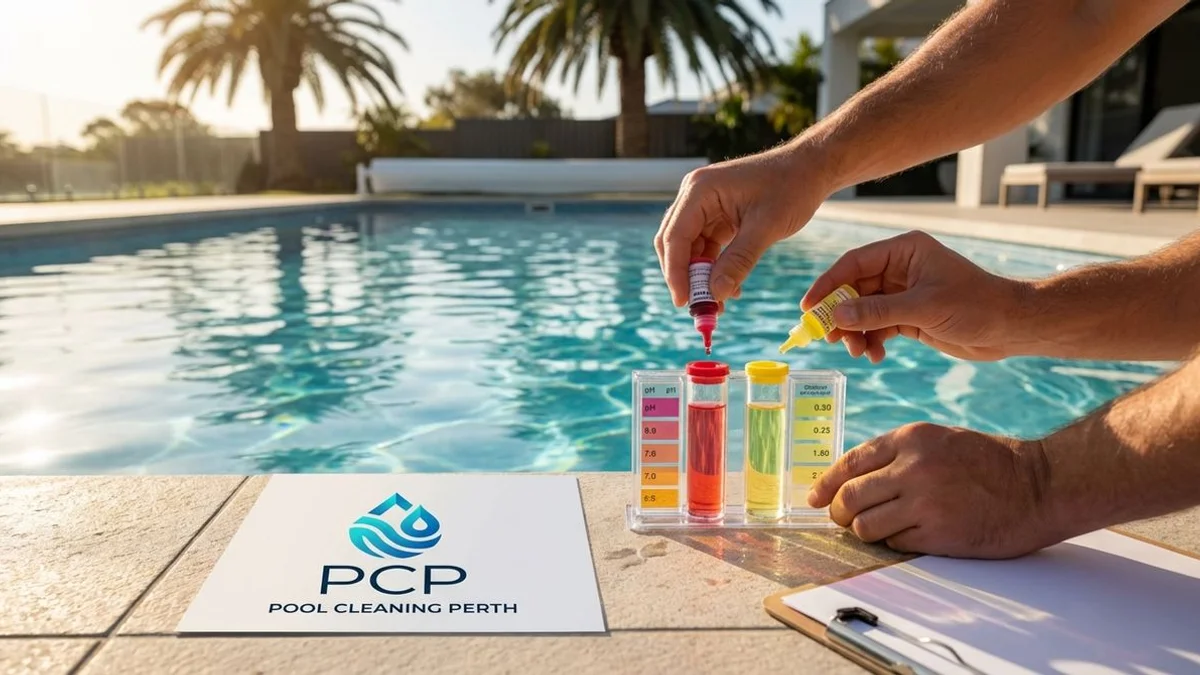
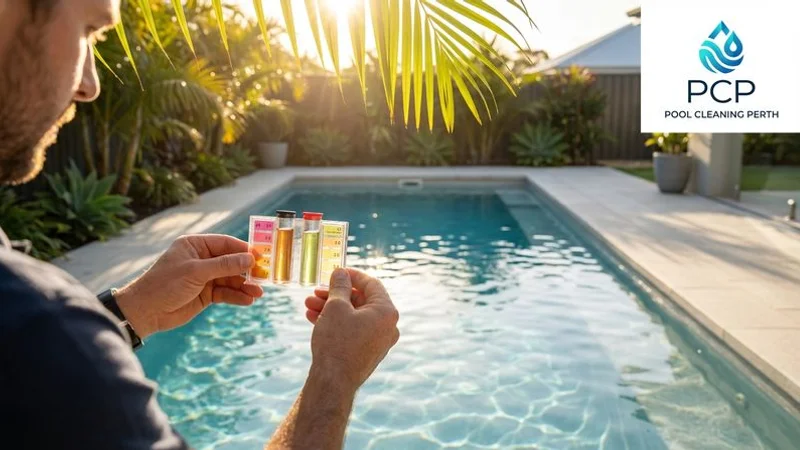
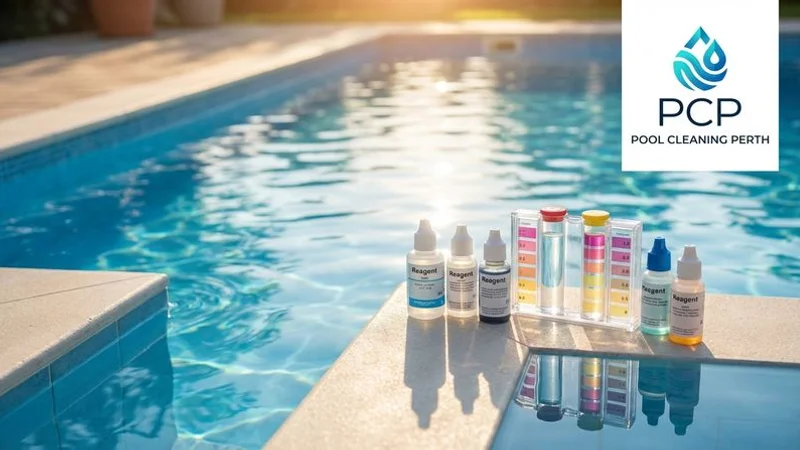
These are the most accurate option available to pool owners. They use colour-comparison tubes where you add reagent drops to a water sample and compare the resulting colour to a reference chart.
Pros: Accurate, affordable ($40 to $80), tests multiple parameters Cons: Requires careful technique, reagents expire (typically annually)
We recommend liquid test kits over test strips for Perth pool owners. The accuracy difference is significant, especially for parameters like stabiliser and alkalinity where precise readings matter.
Test Strips
Test strips are dipped in pool water and compared to a colour chart on the bottle.
Pros: Quick, easy, inexpensive Cons: Less accurate, readings can be ambiguous, limited parameter range, affected by age and storage conditions
Test strips are adequate for a quick chlorine and pH check between proper tests, but they should not be your primary testing method.
Professional Water Testing
Pool shops offer free or low-cost water testing using digital photometers or electronic testing equipment. These provide the most accurate results and can test for parameters that home kits cannot, such as total dissolved solids, phosphates, and metals.
We recommend having your water professionally tested at least once per month during summer and every 6 to 8 weeks during winter, even if you test at home between visits.
Testing Schedule Summary
| Parameter | Summer (Dec-Apr) | Winter (May-Aug) | Spring/Autumn |
|---|---|---|---|
| Free chlorine | Twice weekly | Weekly | Twice weekly |
| pH | Twice weekly | Weekly | Twice weekly |
| Total alkalinity | Weekly | Fortnightly | Weekly |
| Stabiliser (CYA) | Monthly | Bi-monthly | Monthly |
| Calcium hardness | Monthly | Bi-monthly | Monthly |
| Salt (if saltwater) | Monthly | Monthly | Monthly |
| TDS | Quarterly | Quarterly | Quarterly |
How to Take a Proper Water Sample
The accuracy of your test depends on getting a representative water sample:
- Take the sample away from return jets (at least 50cm away). Water near returns has higher chlorine concentration from recent chlorinator output.
- Collect from elbow depth (approximately 30 to 40cm below the surface). Surface water is affected by UV and may give lower chlorine readings.
- Test immediately after collecting the sample. Chlorine begins dissipating from the moment you collect it, especially in sunlight.
- Rinse your test tubes with pool water before testing. Residue from previous tests can affect results.
- Test in shade where possible. Bright sunlight can affect colour-reading accuracy.
Common Testing Mistakes
- Using expired reagents: Reagent chemicals degrade over time, especially in Perth’s heat. Replace your test kit annually.
- Testing after adding chemicals: Wait at least 4 hours (preferably a full pump cycle) after adding chemicals before testing.
- Testing after rain: Rain dilutes pool water and alters pH. Test after the pump has run for several hours post-rain.
- Ignoring stabiliser: This is the most commonly overlooked parameter. If you are not testing stabiliser at least monthly, you could be heading toward over-stabilisation without knowing it.
When Your Water Chemistry Is Confusing
Sometimes water chemistry does not behave as expected. The chlorine keeps dropping despite adding more. The pH will not stay put. The water is cloudy even though all numbers look right. These situations usually indicate an underlying issue that simple chemical adjustment will not fix:
- High stabiliser locking up chlorine
- High phosphate levels feeding algae despite adequate chlorine
- Filter not functioning properly, allowing particles to remain in the water
- Source water issues (bore water introducing metals or minerals)
If you are struggling to maintain balanced water despite regular testing and chemical adjustment, a professional assessment can identify the root cause and save you money on wasted chemicals.
Pool Cleaning Perth provides comprehensive water testing and chemistry management as part of our regular servicing plans. If your water chemistry is giving you trouble, or if you simply want the peace of mind that comes with professional management, call us on 08 7943 6637. We service pools across the entire Perth metropolitan area.
Need Professional Pool Help?
Our team of experienced technicians is ready to help with all your pool needs across Perth.
Get a Free Quote