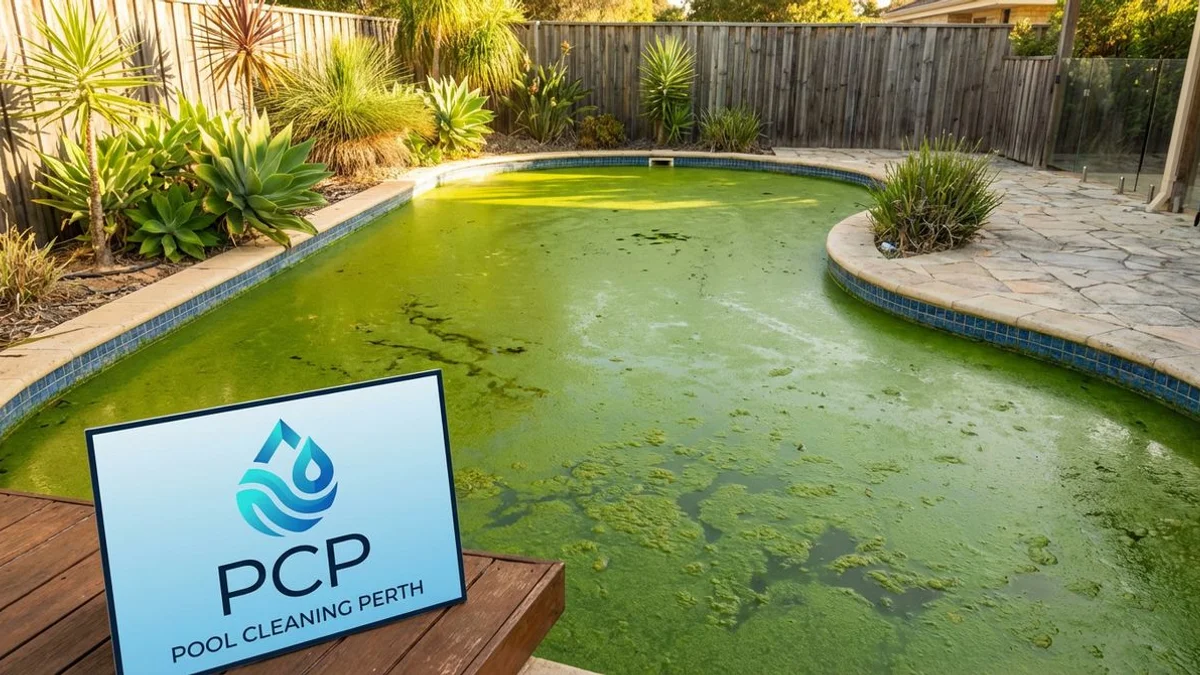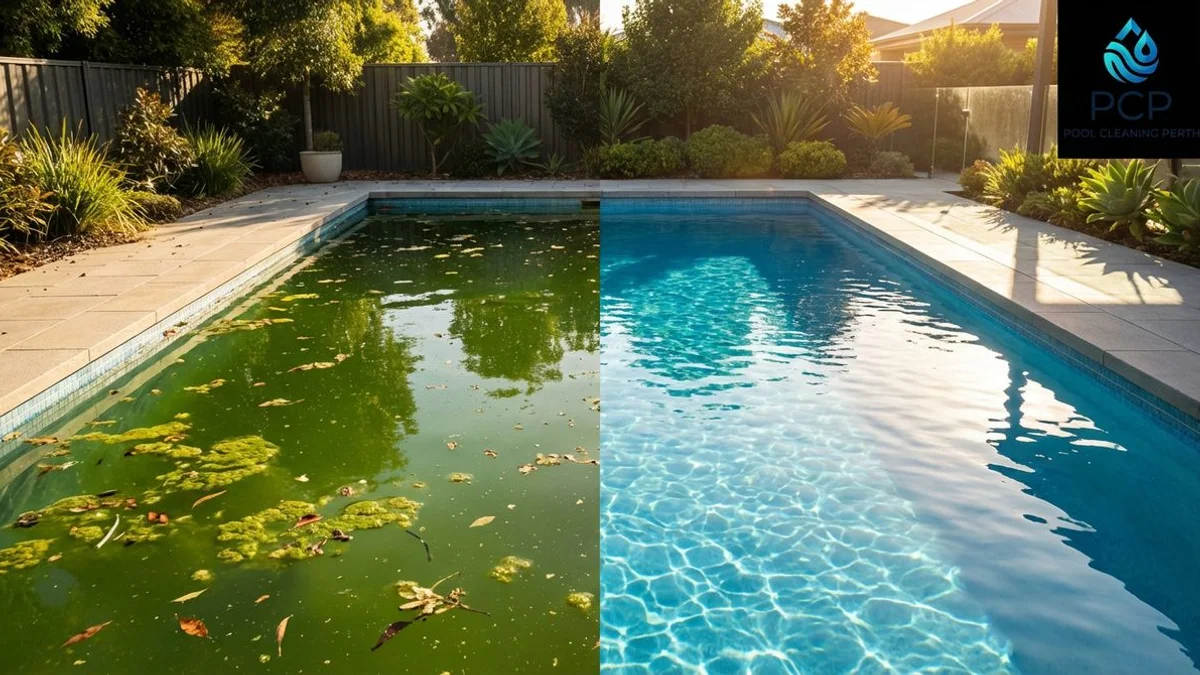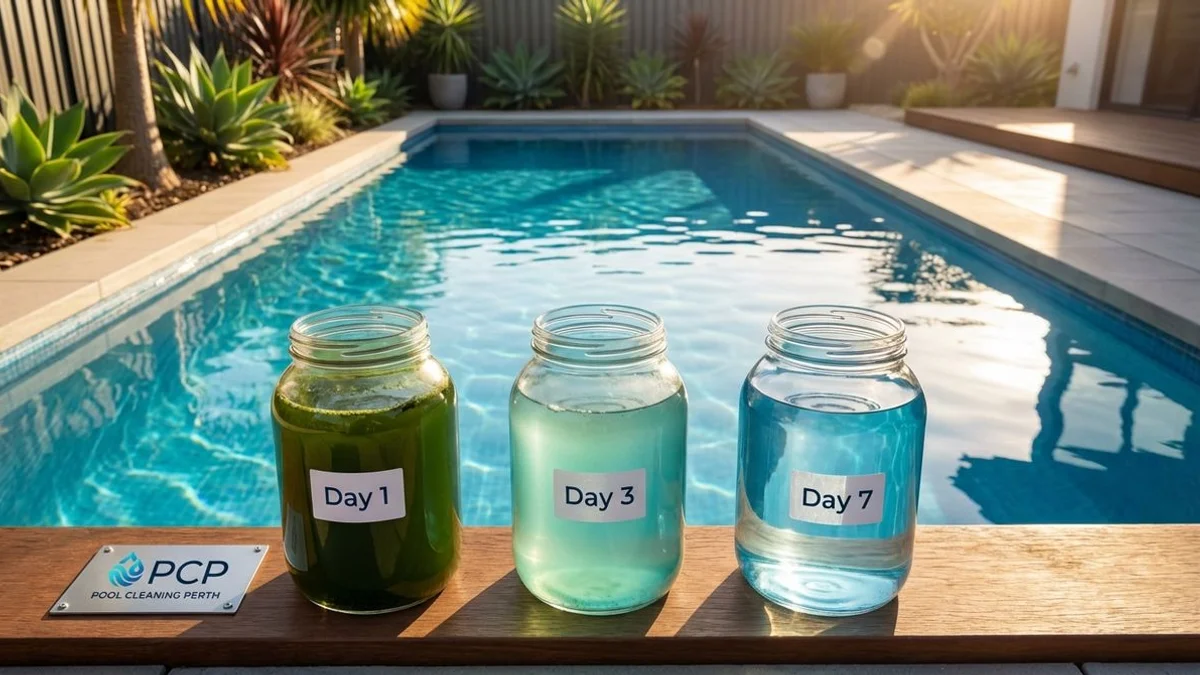
When your pool turns green, the first question after “how much will it cost?” is almost always “how long will it take to fix?” The answer depends on several factors, but understanding the typical timeline helps you plan and set realistic expectations.
Here is what to expect at each stage of green pool recovery in Perth, from the initial assessment through to the moment you can safely swim again.
Recovery Timelines by Severity
Mild Green Pool: 2 to 3 Days
What it looks like: The water has a green or blue-green tint. You can still see the floor of the pool, at least in the shallow end. The walls may feel slightly slippery.
Day 1: Assessment, water testing, and initial shock treatment. The pH is adjusted to around 7.2, and a large dose of liquid chlorine is added to raise free chlorine to 10 to 15 ppm. The pump is set to run continuously. The water will initially look worse as dead algae clouds it.
Day 2: The water should be noticeably lighter. A follow-up visit includes retesting chemical levels, adding more chlorine if needed, and cleaning the filter. Dead algae begins settling to the floor.
Day 3: The water should be clear or nearly clear. Final vacuuming removes dead algae from the floor. Chemical levels are adjusted to normal maintenance ranges. You can typically swim within a few hours of the final treatment once chlorine drops to safe levels (below 5 ppm).
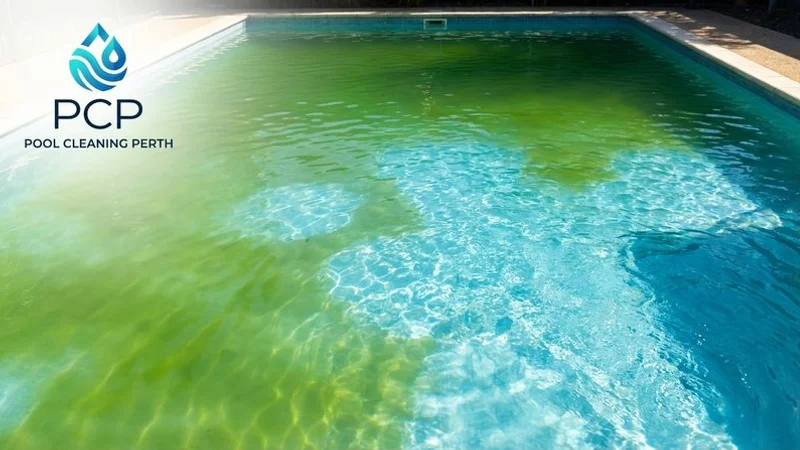
Moderate Green Pool: 4 to 5 Days
What it looks like: The water is solidly green and opaque. You cannot see the floor at all. The shallow end may have limited visibility to about 30 centimetres depth.
Day 1: Assessment, comprehensive water testing, and heavy shock treatment. Stabiliser levels are tested carefully because over-stabilisation is a common reason moderate green pools do not respond to treatment. If stabiliser is too high, a partial drain may be required before chemical treatment can proceed.
Day 2: The water may still be green but should be lighter. The filter is cleaned (it will be clogged with dead algae). More chlorine is added to maintain elevated levels. Algaecide may be added as a secondary treatment.
Day 3: Significant clearing should be visible. The water may look cloudy white-green as dead algae suspends in the water column. Another filter clean is essential at this stage.
Day 4: The water should be clearing substantially. Vacuuming begins to remove settled dead algae from the floor. Chemical levels are maintained and the filter is cleaned again.
Day 5: Final clearing. The water should be blue and mostly clear, though slight cloudiness may persist for another day. Final chemical balance for ongoing maintenance.
Severe Green Pool: 7 to 10 Days
What it looks like: Dark green, almost black water. There may be visible sludge on the surface, a strong swampy odour, and organic matter growing on pool walls. This is typical of pools that have been neglected for months or where the pump has not been running for an extended period.
Days 1-2: Assessment determines whether chemical recovery or a drain and clean is the better approach. If chemical treatment is viable, a massive shock dose is administered. The pump must run 24 hours a day. Multiple filter cleans may be needed in the first 48 hours alone.
Days 3-5: Gradual colour change from dark green to lighter green to cloudy. The filter requires repeated cleaning as it becomes overwhelmed with dead algae. Additional chemicals are added as needed.
Days 6-8: The water continues clearing. Multiple vacuum sessions remove thick layers of dead algae from the floor. Walls and steps are brushed to remove embedded algae.
Days 9-10: Final clearing, chemical balance, and equipment assessment. The pool should be swimmable, but ongoing monitoring is recommended for the following week.
What Slows Down Recovery
Several factors can extend the recovery timeline beyond these estimates:
High Stabiliser Levels
This is the single biggest factor that slows or prevents recovery in Perth pools. When cyanuric acid exceeds 80 ppm, chlorine becomes progressively less effective. At 100+ ppm, even massive chlorine doses have minimal impact on algae.
The only solution is to partially drain the pool and refill with fresh water to dilute the stabiliser. This adds 1 to 2 days to the process, plus the cost of water.
Undersized or Faulty Equipment
A pump that is too small for the pool, a filter that is past its effective life, or a chlorinator that is not producing sufficient output will all slow recovery. In some cases, equipment needs to be repaired or replaced before recovery can succeed.
Pool Size
A large pool (70,000 litres or more) simply takes longer to treat than a smaller pool. Chemical distribution takes longer, filtration takes longer, and vacuuming takes longer.
Weather
Hot weather during treatment actually helps because heat improves chemical reaction rates and chlorine distribution. However, it also means the pool consumes chlorine faster, requiring more frequent top-ups. Cool, overcast weather in Perth’s winter months slows the chemical process slightly.
When a Drain and Clean Is Faster
Sometimes, chemical treatment is not the fastest or most cost-effective option. A full drain and clean may be recommended when:
- Stabiliser is extremely high (above 150 ppm) and would require draining most of the pool anyway
- The pool has been neglected for six months or more and has thick organic sludge on the floor
- There is significant staining from tannins, metals, or organic matter that chemical treatment will not remove
- The pool surface needs inspection for damage that cannot be assessed through green water
- Equipment problems make continuous pumping unreliable
A drain and clean typically takes 2 to 3 days from start to finish, which can actually be faster than a 7 to 10 day chemical recovery for severely neglected pools.
How to Speed Up Recovery
If you are working with a professional, they will manage the process for optimal speed. But if you want to help things along:
- Run the pump 24 hours a day during treatment. Do not reduce run time, even to save on electricity. The cost of extra pump run time is minimal compared to the cost of extending recovery.
- Brush the pool walls and floor daily during recovery. This breaks up algae colonies and exposes them to the chlorine in the water.
- Remove large debris manually before and during treatment. Leaves, branches, and other organic matter consume chlorine and feed algae.
- Keep the filter clean. Check it twice daily during recovery and clean it whenever pressure rises 5 psi above clean.
- Do not swim until recovery is complete and chemical levels are confirmed safe. Premature use introduces contaminants that slow the process.
What Happens After Recovery
Once your pool is clear, the work is not quite done. Post-recovery steps are critical to prevent a recurrence:
- Continue elevated chlorine monitoring for at least two weeks after recovery
- Address the root cause (repair faulty equipment, adjust maintenance schedule, manage stabiliser levels)
- Consider ongoing professional servicing to prevent future green pool events
- Schedule a follow-up water test one to two weeks after recovery to confirm chemical stability
Pool Cleaning Perth handles green pool recovery of all severities across the Perth metro area. If your pool has gone green, the sooner you act, the faster and cheaper the recovery. Call us on 08 7943 6637 for a same-day assessment and we will get your pool back to clear blue as quickly as possible.
Need Professional Pool Help?
Our team of experienced technicians is ready to help with all your pool needs across Perth.
Get a Free Quote